
The AG's Illegal Advice:
- PROLOGUE: A Campaign Donation, a Blocked Whistleblower, and an Admission That Should Concern Every Voter
Before the 2024 election, State Representative Brandon Mitchell received campaign donations and endorsement from the Fraternal Order of Police (FOP) Lodge 10. He then used his campaign Facebook page to engage with constituents—until one constituent commented on the page about police bribery. 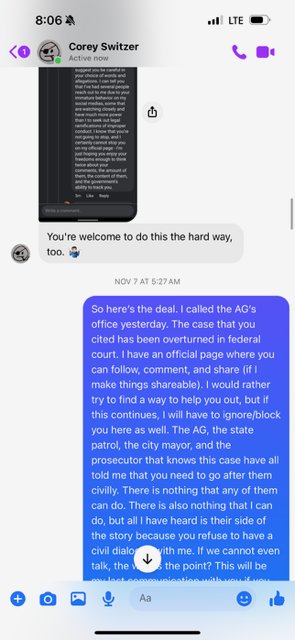 That admission—documented in a Facebook message thread and later in a public records request—raises serious questions about whether Attorney General Labrador used his office to provide illegal campaign assistance to a candidate, and whether Mitchell's subsequent blocking of a whistleblower was a coordinated effort to silence criticism of law enforcement corruption.
- CHAPTER I: The Fraternal Order of Police Donations
### Section I.1: The FOP Connection
Before the 2024 election, Representative Brandon Mitchell received campaign donations and endorsement
That admission—documented in a Facebook message thread and later in a public records request—raises serious questions about whether Attorney General Labrador used his office to provide illegal campaign assistance to a candidate, and whether Mitchell's subsequent blocking of a whistleblower was a coordinated effort to silence criticism of law enforcement corruption.
- CHAPTER I: The Fraternal Order of Police Donations
### Section I.1: The FOP Connection
Before the 2024 election, Representative Brandon Mitchell received campaign donations and endorsement
📄 View Document
That constituent was me.
I commented on Mitchell's campaign page about the bribery I had witnessed involving Lewiston Police Captains Rick Fuentes and Andrew Fox (who also happened to be the President of FOP Lodge 10), along with Detective Nick Woods of the Nez Perce County Prosecutor's Office. I reported that I had seen these officers accept cash bribes from Tim Krueger, the owner of Travelland RV, after I was assaulted at work.
Mitchell did not investigate my claims. He did not ask for evidence. Instead, he attempted to blame me, invoked a "social media policy," and then blocked me from his campaign page.
But in the process of blocking me, Mitchell made a stunning admission: he had received legal guidance from Attorney General Raul Labrador before the election regarding how to handle my comments about the bribery. Mitchell, FOP 1
That admission—documented in a Facebook message thread and later in a public records request—raises serious questions about whether Attorney General Labrador used his office to provide illegal campaign assistance to a candidate, and whether Mitchell's subsequent blocking of a whistleblower was a coordinated effort to silence criticism of law enforcement corruption.
- CHAPTER I: The Fraternal Order of Police Donations
### Section I.1: The FOP Connection
Before the 2024 election, Representative Brandon Mitchell received campaign donations and endorsement 📄 View Document
from the Fraternal Order of Police (FOP) Lodge 10. The FOP is the same organization whose president, Andrew Fox, was one of the officers I reported for taking bribes from Tim Krueger.
The connection is not coincidental. The FOP's mission is to protect law enforcement officers—including those who may have engaged in misconduct. By accepting donations from the FOP, Mitchell aligned himself with an organization that had a direct interest in protecting the very officers I was reporting.
### Section I.2: The Conflict of Interest
When I commented on Mitchell's campaign page about the bribery, I was reporting crimes committed by the very organization that had donated to his campaign. Mitchell had a conflict of interest: he could either investigate the claims and risk alienating his donors, or he could silence the whistleblower and protect his donors.
He chose to silence the whistleblower.
- CHAPTER II: The Social Media Blocking
### Section II.1: The Comment That Started It All
On November 5, 2024, I posted a comment on Representative Brandon Mitchell's campaign Facebook page. I informed Mitchell that I had witnessed police bribery involving FOP President Andrew Fox, Captain Rick Fuentes, and Detective Nick Woods. I also informed him that I had reported these crimes to the Lewiston Police Department, only to be dismissed.
My comment was not a threat. It was not harassment. It was a lawful exercise of my First Amendment right to petition my elected representative about corruption in law enforcement.
### Section II.2: Mitchell's Response
Mitchell's response was immediate and revealing. He did not ask for evidence. He did not express concern about the allegations. Instead, he invoked a "social media policy" and told me that I had violated it.
In a Facebook Messenger exchange, Mitchell wrote:
> *"Actually you violated my social media policy. Give me you number and we can talk. I want to give you some advice"*
I responded:
> *"Your specific social media policy doesn't supercede the~ SCOTUS ruling."*
I was referring to the Supreme Court's decision in **Lindke v. Freed** (2024), which held that government officials cannot block constituents from their social media pages when those pages are used for official business.
Mitchell then made a statement that would prove to be his undoing.
### Section II.3: The Admission
In the same Facebook Messenger exchange, Mitchell admitted that he had received **legal guidance from Attorney General Raul Labrador** regarding how to handle my comments:
> *"I want to give you some advice."*
When I pressed him on the nature of that advice, Mitchell revealed that he had spoken with Labrador not once, but **twice** before the election. He had sought and received legal guidance from the state's top law enforcement officer on how to handle a constituent who was reporting police corruption.
This admission is documented in the Facebook message thread that was later produced in response to a public records request.
- CHAPTER III: The Admission of Legal Guidance
### Section III.1: The Two Conversations
In the Facebook Messenger exchange, Mitchell stated that he had spoken with Attorney General Raul Labrador on at least two occasions. The conversations occurred before the election, while Mitchell was a candidate seeking office.
Mitchell's admission is significant for several reasons:
1. Timing: The conversations occurred before the election, meaning Mitchell was a candidate—not yet an elected official—when he received legal guidance from the Attorney General.
2. Subject Matter: The conversations concerned how Mitchell should handle a constituent who was reporting police corruption—a matter that directly involved the Attorney General's office, which has oversight of law enforcement.
3. Nature of the Advice: Mitchell's statement suggests that Labrador provided specific guidance on how to silence a whistleblower, rather than advising Mitchell to investigate the claims or refer them to the proper authorities.
### Section III.2: The Public Records Request
After Mitchell admitted to receiving legal guidance from Labrador, I submitted a public records request to the Idaho Legislative Services Office (LSO) seeking:
1. Transcripts or recordings of the telephone conversations between Mitchell and Labrador.
2. All correspondence between Mitchell and Labrador regarding the blocking of constituents on social media.
3. All correspondence between Mitchell and Nick Woods, Dan Johnson, or other officials regarding my complaints.
The LSO responded that there were "no responsive records" to my request. However, the LSO did provide the Facebook message thread—the very thread in which Mitchell admitted to receiving legal guidance from Labrador.
### Section III.3: The LSO's Refusal to Certify
When I requested that the LSO certify the records as true and accurate, Elizabeth Bowen, Legal Counsel for the LSO, refused:
> *"We will not be certifying a Facebook thread. It is not a record that LSO has any legal obligation to certify. If you disagree, you may make your argument to a court."*
Bowen also stated:
> *"To LSO's knowledge, there is no audio recording or transcript of any meeting between Rep. Mitchell and the Attorney General."*
This response is significant. The LSO acknowledged that Mitchell claimed to have had conversations with Labrador, but they could not produce any records of those conversations. Either the conversations never happened—in which case Mitchell lied—or they happened but were not recorded—in which case Mitchell and Labrador may have intentionally avoided creating a paper trail.
- CHAPTER IV: The Campaign Finance Violation
### Section IV.1: The Legal Framework
Idaho law prohibits the use of public resources for campaign purposes. Idaho Code § 18-2301 et seq. governs campaign finance and election offenses. When a public official—such as the Attorney General—uses their office to provide legal guidance to a candidate, that may constitute a violation of campaign finance laws.
Specifically, Idaho Code § 18-2319 addresses "unlawful use of public funds for political purposes." While this statute primarily addresses the use of public funds, the broader principle is that public officials cannot use their offices to benefit candidates.
### Section IV.2: Labrador's Role
Attorney General **Raul Labrador** is the state's top law enforcement officer. His office has oversight of law enforcement agencies, including the Lewiston Police Department. When I reported police bribery to Mitchell, I was reporting conduct that fell within Labrador's jurisdiction.
Instead of advising Mitchell to investigate the claims or refer them to the proper authorities, Labrador allegedly advised Mitchell on how to silence me. This is a misuse of his office for campaign purposes.
### Section IV.3: The Timing
The conversations occurred before the election, while Mitchell was a candidate. Labrador's advice helped Mitchell avoid dealing with a difficult constituent issue—an issue that could have damaged his campaign if it had been properly investigated.
By providing legal guidance to a candidate, Labrador may have violated Idaho's campaign finance laws. The Sunshine Office, which handles campaign finance complaints, confirmed that this issue is "not within our purview" and directed me to the county prosecutor, Justin Coleman
But the county prosecutor is Justin Coleman—the same prosecutor whose office includes Detective Nick Woods, one of the officers I reported for bribery. Coleman has demonstrated a pattern of protecting the network, as documented in LCV Blotter's previous investigations.
- CHAPTER V: The Pattern of Protection
### Section V.1: The Network
The Mitchell-Labrador incident is part of a larger pattern of corruption in Idaho politics.
- Brandon Mitchell accepted donations from the FOP and then silenced a whistleblower who reported FOP-related corruption.
- Raul Labrador provided legal guidance to Mitchell on how to silence that whistleblower.
- The LSO refused to certify the records that would have documented the misconduct.
- The Sunshine Office deflected the complaint, sending it back to the very prosecutor who is part of the network.
- Justin Coleman has repeatedly failed to investigate corruption involving his office and its allies. [1], [2]
### Section V.2: The First Amendment Violation
By blocking me on his campaign page, Mitchell violated my First Amendment rights, as established by the Supreme Court in Lindke v. Freed (2024). The Court held that government officials cannot block constituents from social media pages that are used for official business.
Mitchell's campaign page was used for official business—he was seeking election to a public office, and he used the page to communicate with constituents. By receiving legal advice from Labrador regarding blocking me, he silenced a constituent who was reporting corruption.
### Section V.3: The Campaign Violation
Labrador's provision of legal guidance to Mitchell constitutes a campaign violation. Public officials cannot use their offices to benefit candidates. By advising Mitchell on how to handle a constituent complaint, Labrador used his office for campaign purposes.
The Sunshine Office confirmed that this issue is "not within our purview" and directed me to the county prosecutor. But the county prosecutor is Justin Coleman—the same prosecutor who has protected the network at every turn.
- CHAPTER VI: The Unanswered Questions
### Section VI.1: Questions for Brandon Mitchell
1. Did you receive campaign donations from the Fraternal Order of Police?
2. Did you receive legal guidance from Attorney General Raul Labrador before the election?
3. What specific advice did Labrador give you regarding my comments?
4. Did Labrador advise you to block me on social media?
5. Why did you block me on social media?
6. Did you investigate my claims of police bribery?
### Section VI.2: Questions for Raul Labrador
1. Did you provide legal guidance to Brandon Mitchell before the election?
2. What specific advice did you give him?
3. Did you advise him to block a constituent on social media?
4. Did you investigate the claims of police bribery that were reported to Mitchell?
5. Did you have any role in the dismissal of my complaints to the Lewiston Police Department?
### Section VI.3: Questions for the Idaho Legislative Services Office
1. Why did you refuse to certify the Facebook message thread as a public record?
2. Why did you claim there were "no responsive records" to my request for transcripts of Mitchell's conversations with Labrador?
3. Did you investigate whether Mitchell's conversations with Labrador occurred?
4. Why did you refuse to provide a formal denial of my records request, as required by law?
### Section VI.4: Questions for the Sunshine Office
1. Why did you refuse to investigate this campaign violation?
2. Why did you direct me to the county prosecutor, who has a conflict of interest?
3. Who has jurisdiction over campaign violations involving the Attorney General?
- CONCLUSION: The Public's Right to Know
The Mitchell-Labrador incident is a microcosm of the corruption that pervades Idaho politics. A candidate accepted donations from a law enforcement organization, silenced a whistleblower who reported corruption in that organization, and received legal guidance from the state's top law enforcement officer on how to do it.
The network that protects these individuals has a pattern of shielding the powerful while punishing those who challenge them.
- Brandon Mitchell silenced a whistleblower and accepted illegal campaign assistance.
- Raul Labrador used his office for campaign purposes to advise Brandon Mitchell to block the complaint.
- The LSO refused to certify public records produced by Brandon Mitchell.
- The Sunshine Office deflected the complaint to Justin Coleman.
- Justin Coleman protected the network.
The public deserves answers. The public deserves transparency. And the public deserves to know whether their elected officials are serving the public interest or protecting themselves.
- TIMELINE OF EVENTS
| Date | Event |
| :--- | :--- |
| 2020-2021 | I witness police bribery involving Rick Fuentes, Andrew Fox, and Nick Woods. |
| April 2022 | I report embezzlement and tax evasion at Travelland RV to Officer Andrew Fox, Detective Nick Woods. No action is taken. |
| October 2024 | Brandon Mitchell receives campaign donations from the Fraternal Order of Police No. 10. |
| Before Nov 2024 | Brandon Mitchell receives legal guidance from Attorney General Raul Labrador on at least two occasions. |
| Nov 5, 2024 | I comment on Mitchell's campaign page about police bribery. Mitchell blocks me. |
| Nov 7, 2024 | I submit a public records request to the LSO seeking records of Mitchell's conversations with Labrador.
| Nov 13, 2024 | The LSO acknowledges receipt and notifies me that up to 21 working days may be needed. |
| Dec 11, 2024 | The LSO responds, stating there are "no responsive records" to my request, but provides the Text Message History by Rep. Mitchell |
| Dec 12, 2024 | The LSO refuses to certify the Facebook message thread as a public record. |
| Dec 13, 2024 | I contact the Sunshine Office about the campaign violation. |
| Dec 17, 2024 | The Sunshine Office directs me to the county prosecutor. |
| Dec 19, 2024 | The Sunshine Office confirms the issue is "not within our purview." to investigate campaign violations |
- SOURCE EXHIBITS
| Exhibit | Description |
| :--- | :--- |
| Gmail - Public records request (1).pdf | Email chain with the LSO regarding the public records request, including the Facebook message thread and the LSO's refusal to certify. |
| Gmail - Election Campaign Interference, AG Labrador.pdf | Email chain with the Sunshine Office regarding the campaign violation complaint. |Mitchell, FOP 2
📄 View Document
This article is a publication of LCV Blotter, an independent watchdog journalism project. All documents cited are public records and are available upon request.
The investigator is visually impaired, has no income, and has spent five years documenting a pattern of corruption that crosses state lines.
The cover‑up is exposed. The receipts are public. The process continues. Sunshine
💬 Comments
No comments yet.
Leave a comment